
Introduction
Pain is one of the most common reasons adults in the USA seek medical care. For years, opioid medications were prescribed freely for a wide range of pain conditions. Today, doctors and patients are increasingly aware of the risks associated with opioids—including addiction, respiratory depression, and overdose.
The good news is that effective non-opioid alternatives exist for many types of pain. These options range from over-the-counter medications and prescription non-opioids to physical therapy, injections, and mind-body techniques.
This educational guide explores the full spectrum of non-opioid pain relief options. This information is for educational purposes only and does not replace professional medical advice. Always consult a licensed healthcare provider before starting any new treatment.
Why Consider Non-Opioid Pain Relief?
Before exploring specific options, it helps to understand why non-opioid alternatives are often preferred—especially for chronic pain.
The Opioid Challenge
Opioids (such as oxycodone, hydrocodone, morphine, and tapentadol) are effective for certain types of pain, but they carry significant risks:
- Addiction and misuse – Millions of Americans have developed opioid use disorder
- Tolerance – Over time, higher doses are needed to achieve the same effect
- Respiratory depression – A potentially fatal side effect, especially at higher doses
- Constipation, nausea, and sedation – Common side effects that affect quality of life
- Withdrawal symptoms – Stopping opioids suddenly can be very uncomfortable
The Benefits of Non-Opioid Approaches
Non-opioid pain relief options offer several potential advantages:
- Lower risk of addiction and dependence
- No risk of respiratory depression (for most non-opioids)
- May be used long-term with fewer safety concerns
- Can be combined with other treatments for better results
- Often address underlying causes rather than just masking pain
💡 For many pain conditions, non-opioid treatments are recommended as first-line therapy before considering opioids.
Over-the-Counter (OTC) Pain Relievers
These medications are available without a prescription and are often the first line of defense against mild to moderate pain.
Acetaminophen (Tylenol®)
Best for: Mild to moderate pain, including headaches, muscle aches, backaches, and fever
How it works: Acetaminophen reduces pain signals in the brain. Unlike NSAIDs, it does not reduce inflammation.
Typical dosage: 325 mg to 650 mg every 4-6 hours (maximum 3,000-4,000 mg per day)
Important safety notes:
- Do not exceed the recommended dose – liver damage can occur
- Avoid alcohol while taking acetaminophen
- Check other medications (many cold and flu products contain acetaminophen)
Nonsteroidal Anti-Inflammatory Drugs (NSAIDs)
NSAIDs reduce pain, inflammation, and fever. Common OTC options include:
| Medication | Brand Name(s) | Typical Strength |
|---|---|---|
| Ibuprofen | Advil®, Motrin® | 200 mg, 400 mg, 600 mg |
| Naproxen | Aleve®, Naprosyn® | 220 mg, 275 mg, 500 mg |
| Aspirin | Bayer®, Ecotrin® | 325 mg, 500 mg |
Best for: Inflammatory conditions (arthritis, muscle strains, menstrual cramps, dental pain)
How they work: NSAIDs block enzymes (COX-1 and COX-2) that produce inflammatory chemicals called prostaglandins.
Important safety notes:
- Can cause stomach irritation, ulcers, and bleeding
- May increase risk of heart attack and stroke (especially with long-term use)
- Can affect kidney function
- Do not take with blood thinners without medical approval
Topical NSAIDs
Examples: Diclofenac gel (Voltaren®)
Best for: Localized pain in joints or muscles (e.g., osteoarthritis of the hands or knees)
Advantage: Applied directly to the skin, minimizing systemic side effects
Prescription Non-Opioid Medications
When OTC options are insufficient, doctors may prescribe stronger non-opioid medications.
Prescription-Strength NSAIDs
Examples: Celecoxib (Celebrex®), meloxicam (Mobic®), prescription-strength ibuprofen or naproxen
Best for: Moderate inflammatory pain, arthritis, acute injuries
Note: Celecoxib is a COX-2 selective NSAID, which may cause less stomach irritation than non-selective NSAIDs.
Antidepressants for Pain
Certain antidepressants are effective for chronic pain, especially neuropathic (nerve) pain.
| Medication | Class | Best For |
|---|---|---|
| Duloxetine (Cymbalta®) | SNRI | Diabetic neuropathy, fibromyalgia, chronic back pain |
| Amitriptyline (Elavil®) | Tricyclic | Neuropathic pain, migraines, fibromyalgia |
| Nortriptyline (Pamelor®) | Tricyclic | Neuropathic pain (fewer side effects than amitriptyline) |
| Venlafaxine (Effexor XR®) | SNRI | Neuropathic pain, fibromyalgia |
How they work: These medications increase levels of serotonin and/or norepinephrine in the nervous system, which helps modulate pain signals.
Important note: Pain-relieving effects occur at lower doses than those used for depression and often work within 1-2 weeks for pain.
Anticonvulsants (Anti-Seizure Medications) for Pain
These medications stabilize overactive nerves and are highly effective for certain pain types.
| Medication | Brand Name(s) | Best For |
|---|---|---|
| Gabapentin | Neurontin® | Diabetic neuropathy, post-herpetic neuralgia, fibromyalgia |
| Pregabalin | Lyrica® | Diabetic neuropathy, post-herpetic neuralgia, fibromyalgia, spinal cord injury pain |
How they work: These medications bind to calcium channels in nerve cells, reducing the release of pain-signaling chemicals.
Common side effects: Drowsiness, dizziness, swelling in the extremities (edema)
Muscle Relaxants
Examples: Cyclobenzaprine (Flexeril®), baclofen (Lioresal®), tizanidine (Zanaflex®), methocarbamol (Robaxin®)
Best for: Muscle spasms and acute back or neck pain
Duration of use: Typically prescribed for short-term use (2-3 weeks) due to sedation side effects and limited evidence for long-term benefit.
Corticosteroids (Oral or Injectable)
Examples: Prednisone, methylprednisolone (Medrol®), dexamethasone
Best for: Severe inflammation from conditions like rheumatoid arthritis, gout, or radiculopathy (pinched nerve)
Important note: Long-term use carries significant risks (weight gain, high blood sugar, bone loss, infection risk). Usually prescribed for short courses or intermittent use.
Topical Pain Relievers (Prescription and OTC)
Topical medications are applied directly to the skin over the painful area.
| Type | Examples | Best For |
|---|---|---|
| Lidocaine patches/cream | Lidoderm®, Aspercreme® | Localized neuropathic pain (post-herpetic neuralgia) |
| Capsaicin cream | Zostrix® | Osteoarthritis, neuropathic pain |
| Menthol/camphor | Bengay®, Icy Hot® | Minor muscle and joint pain |
| Diclofenac gel | Voltaren® (now OTC) | Osteoarthritis of hands, knees, feet |
Advantages: Minimal systemic absorption means fewer whole-body side effects. Can be used alongside oral medications.
Non-Pharmacological Pain Relief Options
Medications are only one piece of the pain management puzzle. Non-drug approaches are often just as important—sometimes more so—for chronic pain.
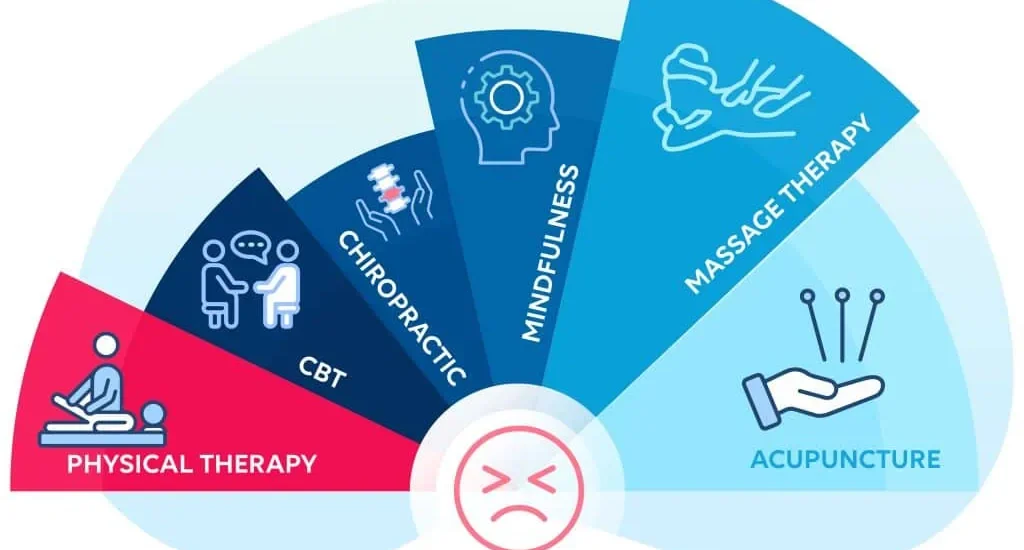
Physical Therapy (PT)
Physical therapy is one of the most effective non-opioid treatments for many pain conditions.
What it involves: Stretching, strengthening exercises, manual therapy, posture training, and education
Best for:
- Chronic lower back pain
- Osteoarthritis (hip, knee)
- Neck pain
- Post-surgical recovery
- Fibromyalgia
Evidence: Strong evidence supports PT for reducing pain and improving function in musculoskeletal conditions.
Cognitive Behavioral Therapy (CBT)
CBT is a type of talk therapy that helps patients change negative thought patterns and behaviors related to pain.
What it involves: Working with a trained psychologist or therapist to develop coping skills, identify triggers, and reduce pain-related distress
Best for: Chronic pain of any type, especially when pain is accompanied by anxiety, depression, or catastrophizing (expecting the worst)
Evidence: Multiple studies show CBT reduces pain severity, improves mood, and increases function in chronic pain patients.
Exercise and Physical Activity
Regular exercise is medicine for chronic pain.
Recommended types:
- Aerobic exercise – Walking, swimming, cycling (reduces overall pain sensitivity)
- Strength training – Improves muscle support around painful joints
- Stretching and flexibility – Yoga, tai chi (improves range of motion and reduces stiffness)
How much: Aim for 150 minutes of moderate-intensity exercise per week, starting slowly and gradually increasing.
Acupuncture
Acupuncture involves inserting thin needles into specific points on the body.
Best for: Chronic lower back pain, osteoarthritis, neck pain, migraines, tension headaches
Evidence: Moderate to strong evidence for certain pain conditions. The National Institutes of Health (NIH) acknowledges acupuncture as a reasonable option for several pain types.
Chiropractic Care
Chiropractic treatment focuses on spinal manipulation and joint adjustments.
Best for: Acute and chronic lower back pain, neck pain, headaches
Evidence: Moderate evidence for short-term relief of lower back pain. Often covered by health insurance plans.
Massage Therapy
Massage can reduce muscle tension, improve circulation, and promote relaxation.
Best for: Muscle tension, stress-related pain, fibromyalgia, chronic neck and back pain
Duration: Benefits are often short-term; regular sessions may be needed.
Mind-Body Techniques
These approaches focus on the connection between mental state and physical pain.
| Technique | Best For | Evidence Level |
|---|---|---|
| Meditation / Mindfulness | Chronic pain, stress-related pain | Strong |
| Deep breathing exercises | Anxiety-related pain, acute stress | Moderate |
| Progressive muscle relaxation | Tension headaches, fibromyalgia | Moderate |
| Guided imagery | Post-surgical pain, cancer pain | Moderate |
| Yoga / Tai Chi | Lower back pain, fibromyalgia, arthritis | Strong |
Interventional Pain Procedures
For patients with severe pain that has not responded to other treatments, interventional procedures may be considered.
Nerve Blocks
What it is: Injection of anesthetic (and sometimes corticosteroid) around specific nerves
Best for: Localized neuropathic pain, post-surgical pain, complex regional pain syndrome (CRPS)
Duration: Can provide temporary relief (hours to weeks); sometimes used for diagnostic purposes
Epidural Steroid Injections
What it is: Injection of corticosteroid into the epidural space of the spine
Best for: Radicular pain (sciatica) from herniated discs or spinal stenosis
Duration: Relief can last weeks to months; usually limited to 3-4 injections per year
Radiofrequency Ablation (RFA)
What it is: Use of heat generated by radio waves to temporarily disable specific nerves
Best for: Facet joint pain, sacroiliac joint pain, chronic knee or hip osteoarthritis
Duration: Relief typically lasts 6-12 months
Spinal Cord Stimulation (SCS)
What it is: A device implanted under the skin that sends mild electrical signals to the spinal cord to block pain signals
Best for: Failed back surgery syndrome, CRPS, refractory neuropathic pain
Evidence: Strong evidence for selected patients; requires psychological evaluation before implantation
Combining Non-Opioid Approaches for Best Results
Pain is complex, and no single treatment works for everyone. The most effective pain management plans are often multimodal – combining several approaches.
Example Combination Plans
| Pain Condition | Sample Non-Opioid Plan |
|---|---|
| Osteoarthritis (knee) | Acetaminophen + topical diclofenac + physical therapy + weight loss + exercise |
| Diabetic neuropathy | Duloxetine or gabapentin + exercise + CBT |
| Chronic lower back pain | NSAIDs (as needed) + physical therapy + CBT + regular walking |
| Fibromyalgia | Duloxetine or pregabalin + aerobic exercise + CBT + mindfulness meditation |
| Post-surgical pain | NSAIDs + acetaminophen + nerve block (during surgery) + ice/compression |
H2: When Might Opioids Still Be Considered?
Non-opioid options are preferred for most pain conditions. However, opioids (including tapentadol) may still be considered when:
- Severe acute pain – After major surgery, trauma, or burns where non-opioids are insufficient
- Cancer pain – When non-opioids cannot control severe pain
- End-of-life/palliative care – To maximize comfort
- Selected chronic pain patients – Who have tried and failed non-opioid options and are carefully monitored
⚠️ Even when opioids are used, they should be prescribed at the lowest effective dose for the shortest necessary duration.
Frequently Asked Questions (FAQs)
Q1. Are non-opioid pain relievers safe for long-term use?
Some are, some are not. Acetaminophen is generally safe long-term at recommended doses. NSAIDs carry risks of stomach bleeding, kidney damage, and cardiovascular events with prolonged use. Antidepressants and anticonvulsants can be used long-term under medical supervision. Non-pharmacological options (exercise, PT, CBT) are very safe long-term.
H3: 2. Can I take non-opioid and opioid medications together?
Yes, in some cases. Doctors may prescribe non-opioids (acetaminophen, NSAIDs, gabapentin) alongside lower doses of opioids to achieve better pain control with fewer opioid-related side effects. Never combine medications without medical approval.
Q3. Which non-opioid is best for nerve pain?
Gabapentin, pregabalin, duloxetine, and amitriptyline have the strongest evidence for neuropathic (nerve) pain. Your doctor will choose based on your specific condition, other medications, and side effect profile.
Q4. How long does it take for non-opioid pain treatments to work?
- OTC medications: 30-60 minutes
- Prescription NSAIDs: Days to weeks for full effect
- Antidepressants for pain: 1-3 weeks
- Gabapentin/pregabalin: Days to weeks
- Physical therapy: 4-8 weeks for noticeable improvement
- CBT: 8-12 sessions typically needed
Q5. Are non-opioid options covered by insurance?
Most are. OTC medications are out-of-pocket. Prescription non-opioids are typically covered. Physical therapy, chiropractic care, and CBT are often covered but may require referrals or prior authorization. Acupuncture coverage varies by insurance plan.
Q6. Can exercise make chronic pain worse?
When done incorrectly or too aggressively, yes. However, a properly designed exercise program starting at very low intensity and gradually increasing is safe and beneficial for most chronic pain conditions. Work with a physical therapist or certified trainer experienced in chronic pain.
Conclusion
Non-opioid alternatives for pain relief are numerous, effective, and often safer than opioids for many pain conditions. From over-the-counter medications and prescription non-opioids to physical therapy, acupuncture, and mind-body techniques, patients have more options than ever before.
The best pain management plan is personalized and multimodal – combining medications (when needed) with non-drug approaches that address the whole person, not just the pain.
If you are struggling with pain, speak with your healthcare provider about non-opioid options. Many patients achieve excellent pain control without the risks associated with opioid therapy.
For patients who do require opioids as part of their pain management plan, medications like tapentadol remain available by prescription only – used responsibly and under close medical supervision.
📌 Key takeaway: Non-opioid options should be tried first for most pain conditions. When opioids are necessary, they work best as part of a comprehensive, multimodal plan that includes non-opioid and non-drug approaches.
🚨 This content is for educational and informational purposes only. Tapentadol.org does not provide medical advice, diagnosis, or treatment. Always consult a licensed healthcare provider before starting, stopping, or changing any pain treatment. If you are experiencing a medical emergency, call 911 immediately.